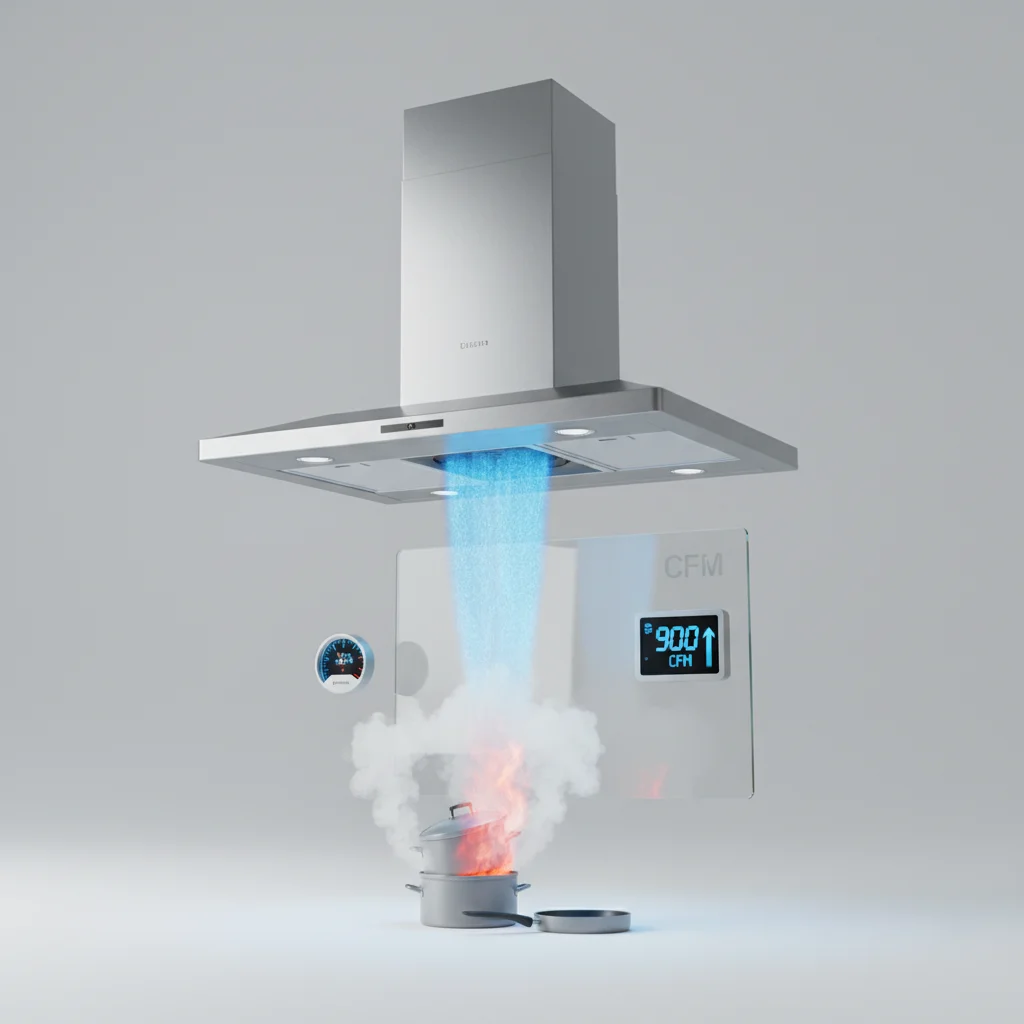
Determining the ideal range hood CFM (Cubic Feet per Minute) for your kitchen is crucial for effective ventilation and maintaining air quality. For most residential kitchens, a range hood with 300-600 CFM is sufficient to handle typical cooking fumes and odors. However, the exact CFM you need depends on several factors, including your stove’s BTU output, kitchen size, and cooking habits.
Understanding CFM and Its Importance
CFM measures the volume of air a range hood can move in one minute. A higher CFM indicates more powerful ventilation, which is essential for kitchens with high-BTU gas ranges or those that frequently engage in heavy cooking, such as frying or grilling. Proper CFM ensures that smoke, grease, and odors are efficiently removed, preventing them from spreading throughout your home and accumulating on surfaces. For shop curated kitchen ventilation on this site.
Insufficient CFM can lead to lingering smells, greasy residue, and poor indoor air quality, potentially exacerbating respiratory issues. Conversely, excessively high CFM might be overkill for a standard kitchen, leading to unnecessary noise and energy consumption.
Calculating Your Range Hood CFM Needs
To accurately calculate your range hood CFM, consider your cooktop’s heat output. For electric cooktops, a general rule of thumb is to multiply the stove width (in inches) by 10. For gas cooktops, you’ll need to sum the BTUs of all burners and divide by 100. For example, a gas range with a total BTU output of 60,000 would require a minimum of 600 CFM (60,000 / 100 = 600).
Another factor is the kitchen’s volume. For every 100 cubic feet of kitchen space, you should aim for at least 15 air changes per hour. This translates to a specific CFM requirement based on your kitchen’s dimensions. Always err on the side of slightly higher CFM if you frequently cook strong-smelling foods or use high-heat methods.
Factors Influencing Optimal CFM
|
Our Picks for the Best Range Hood in 2026
As an Amazon Associate I earn from qualifying purchases.
|
||
| Num | Product | Action |
|---|---|---|
| 1 | Range Hood 30inch Under Cabinet, 900CFM Stainless Steel Kitchen Vent Hood with Gesture/Touch Control and Permanent Stainless Steel Filters, Ducted Vent, Top and Rear Vents |

|
| 2 | AAOBOSI Range Hood 30 inch Under Cabinet,800-CFM Gesture Sensing/Touch Control/Motor Upgrade Low Noise,3 Speed Range Hood with LED Lights Exhaust Fan, Stainless Steel Kitchen Vent Hood |
|
| 3 | COSMO COS-63175S 30 in. Vista Collection 380 CFM Ducted Wall Mount Range Hood, Touch Controls, LED Lights, Stainless Steel |
|
| 4 | VIKIO HOME Wall Mount Range Hood 30 inch, 580 CFM, Ducted/Ductless Convertible, Stainless Steel Kitchen Vent Hood with 3-Speed Fan and LED Lights |
|
| 5 | COSMO COS-5MU30 30 in. Delta Collection Ducted Under Cabinet Range Hood, Button Controls, Reusable Filters, LED Lights, Stainless Steel |
|
| 6 | Empava Ductless/Ducted Range Hood Under Cabinet 30 Inch, Touch Control, 300 CFM Plug in, Stainless Steel |
|
| 7 | Wall Mount Range Hood 30 inch with Ducted/Ductless Convertible Duct, Stainless Steel Chimney-Style Over Stove Vent Hood with LED Light, 3 Speed Exhaust Fan, 450 CFM |
|
| 8 | AMZCHEF Under Cabinet Range Hood 30 Inch, 750CFM Stainless Steel Kitchen Stove Vent Hood 3 Speed Exhaust Fan Touch/Remote/Gesture Control LED lights Time Setting Dishwasher-Safe Baffle Filters |
|
| 9 | Empava Wall Mount Range Hood 30 Inch, Ducted/Ductless Kitchen Exhaust Stove Vent with Modern Style, 400CFM, 3-Speed, Touch Control, Timer, LED Lights, Stainless Steel (Charcoal-Filter Sold Separately) |
|
| 10 | Broan-NuTone BCSQ130SS Three-Speed Glacier Under-Cabinet Range Hood with LED Lights ADA Capable, 1.5 Sones, 375 Max Blower CFM, 30-Inch, Stainless Steel |
|
Several elements beyond just BTU output can influence the optimal CFM for your range hood. The type of cooking you do plays a significant role; frequent stir-frying, deep-frying, or grilling will demand higher CFM than light simmering. The size and layout of your kitchen also matter. Open-concept kitchens may require more powerful ventilation to prevent odors from spreading into living areas.
Ductwork design is another critical consideration. Long, winding ducts with many bends can reduce a range hood’s effective CFM due to increased static pressure. Shorter, straighter duct runs with fewer elbows will allow the range hood to operate more efficiently at its rated CFM.
Choosing the Right Range Hood for Your CFM
Once you’ve determined your ideal CFM, selecting the right range hood becomes easier. Look for models that explicitly state their CFM rating. Many manufacturers offer a range of options, from under-cabinet hoods to wall-mount and island hoods, each with varying CFM capabilities. Consider features like multiple fan speeds, which allow you to adjust ventilation based on your cooking needs, and quiet operation, especially if your kitchen is part of an open living space.
Don’t forget to account for make-up air. If your range hood has a very high CFM (typically above 400 CFM), it might pull air out of your home faster than it can be replaced, leading to negative pressure. This can cause issues like back drafting from furnaces or water heaters. In such cases, a make-up air system might be necessary to introduce fresh air into your home.
- Calculate your stove’s total BTU output.
- Measure your kitchen’s volume for a secondary CFM estimate.
- Consider your typical cooking style and frequency.
- Factor in your ductwork length and bends.
- Research models with variable fan speeds and quiet operation.
Installation Tips for Maximizing CFM Efficiency
Proper installation is key to ensuring your range hood performs at its optimal CFM. Ensure the ductwork is the correct size for your chosen range hood; typically, 6-inch or 8-inch round ducts are recommended for most residential units. Avoid using flexible ducting, as its corrugated interior can significantly impede airflow. Smooth, rigid metal ducting is always the best choice for maximum efficiency.
Minimize the number of elbows and turns in your duct run, as each bend reduces airflow. If turns are unavoidable, use gradual, sweeping elbows rather than sharp 90-degree angles. Ensure all duct connections are sealed with mastic or foil tape to prevent air leaks. A well-installed range hood will not only provide superior ventilation but also operate more quietly and efficiently.
